
Turn rough feature ideas into agent-ready specs.
Describe a feature. ZeNorm asks the hard questions. You get an agent-ready spec.
“Great specs are discovered, not drafted.”
— the thinking behind ZeNorm
Most agent failures start before code: vague intent, missing constraints, hidden edge cases. ZeNorm surfaces those gaps before they become implementation guesses.
Describe it. Answer the hard questions. Run it.
Describe what you want. ZeNorm asks about edge cases and constraints, writes the spec, then your agent runs it end-to-end.
- 01step 01Start with what you knowDescribe the feature in plain language. ZeNorm connects to your repo and reads your codebase — then starts asking the questions you didn't know to ask.step-01# intentAdd a checkout that uses Stripe andhandles failures without losing cart.▍
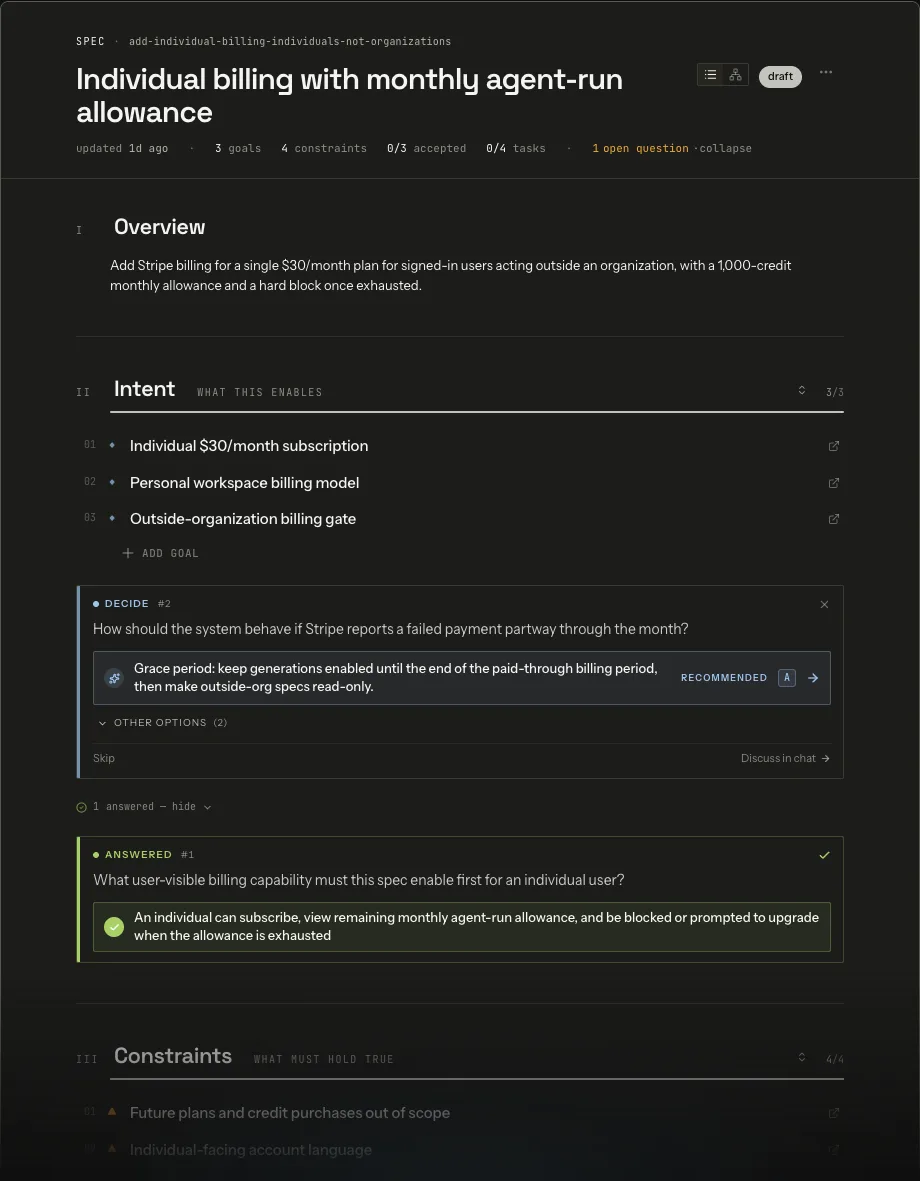
- 02step 02Answer the hard questionsZeNorm asks about edge cases, constraints, and assumptions: the details that become bugs when nobody calls them out. Your answers become goals, constraints, and acceptance criteria. A real spec, not a chat log.step-02› agent asksConfigurable timeout or fixed 15m?✓ configurable per merchant└ spec#0042 · updated
- 03step 03Execute the whole specWhen the spec is ready, run
/zenorm <task-link>in Claude Code. The agent reads the full spec and implements every task end-to-end — constraints, decisions, and edge cases already captured.step-03/zenorm <task-link>→ loading spec context→ implementing in Claude Code✓ on it
One command runs the whole spec.
Author the spec in ZeNorm, then run /zenorm <task-link> in Claude Code. The command pulls the full spec and executes all its tasks, in order.
Run /zenorm <task-link> in Claude Code to execute the whole spec, or pull spec context into any coding agent. The spec carries the context; the agent does the implementation.
Start free. Predictable after.
One plan for solo devs. Teams and orgs talk to us.
Try the full spec workflow during beta. No credit card.
- Spec authoring + /zenorm execution
- Beta usage included
- Open-source CLI
- Personal workspace
For ICs and founders shipping with agents daily.
- $30 monthly usage · spec generation + agent runs
- Stripe billing + self-serve portal
- Personal workspace
- Hard stop at limit — no surprise charges
Shared specs, shared repos, pooled usage. Built around how your team ships.
- Everything in Individual
- Org workspaces with role-based access
- Shared repository connections
- Pooled usage and unified billing
- Priority support
Common questions
What people ask before signing up.
How is this different from just using Claude Code / Cursor?
How do I execute a spec's tasks?
/zenorm <task-link>. The slash command loads the spec context and implements the tasks inside Claude Code. You can also pull spec context into other agents like Cursor or Aider with the CLI. The spec is the contract; the agent is the executor.Do I lose control?
What if the agent gets something wrong?
Why not just write a better prompt?
How does usage work?
Give your agent clearer constraints.
Free to start. No credit card. Describe a feature, answer the edge-case questions, and hand the spec to your agent.